Article Detail
Playing to Strengths in the Age of AI
What I learned from a truck driver who became an engineer.
Over a decade ago, I landed on a team led by a former truck driver and proud Virginia Tech Hokie. He told us something I’d never heard from a boss before:
We won't waste time fixating on our weaknesses. Instead, we'll lean into our strengths and let them propel us forward. We'll handle necessary weaknesses, but we won't let them drag us down.
That was liberating. At the time, many leaders still displayed The Mythical Man-Month on their desks. Yet they often acted as if three women could deliver one baby in three months—a contradiction that treated people as interchangeable units. Same goals, same metrics, same competition.
The result? Teams competed against themselves. Humans are wired to compare like-for-like, so if everyone’s measured by the same ruler, collaboration collapses into rivalry.
---
The American Football Analogy
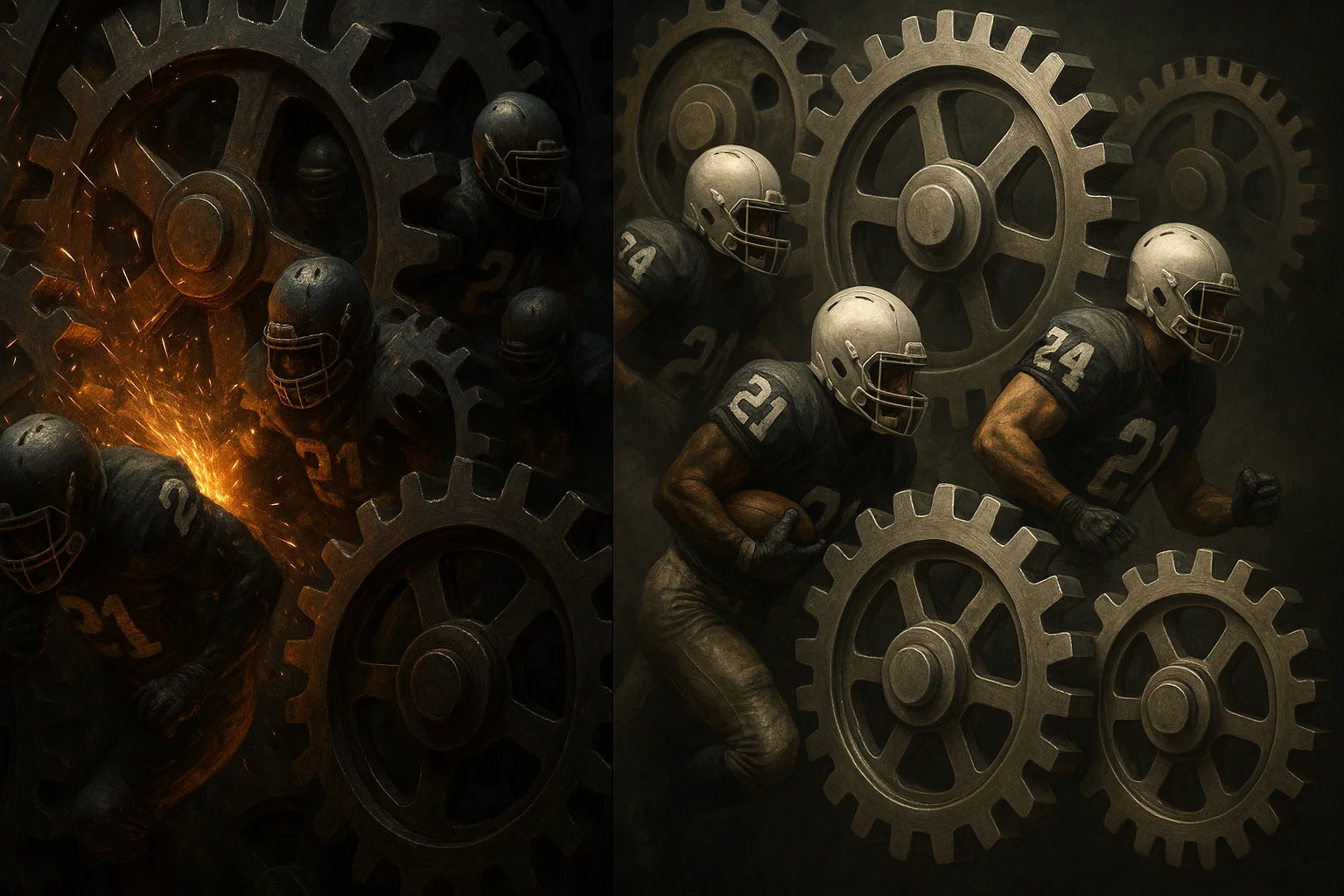
Let’s walk through a progression of plays—chaos turning into a well-oiled machine—that mirrors how teams evolve when managers understand strengths.
Chaos on the Field: The offense lines up with everyone chasing the ball. Linemen sprint downfield trying to score, the kicker fumbles a pass, and nobody’s left to block. It’s a mess. That’s the “everyone has the same goals” stage—confusion, wasted energy, competition instead of coordination.
Patchwork Coverage: A coach tries plugging round pegs into square holes. The wide receiver is asked to tackle, the quarterback to kick field goals. Plays happen, but awkwardly. This is when managers assign goals without considering strengths—barely keeping the lights on.
Finding Roles: Slowly, players are allowed to do what they do best. Linemen block, receivers run routes, the kicker actually kicks. The team begins to cover each other’s weaknesses. This is the shift to tactical agility—knowing who to trust in the heat of the moment.
Building Trust: The team starts cross-training. Backup players step in when needed, and risks are taken because everyone trusts the blockers will be there. This is psychological safety in action—strengths shine brighter when people feel safe to stretch.
Well-Oiled Machine: The game film now shows rhythm: drives executed cleanly, defenses adjusting smartly, players complementing each other’s moves. It’s not that mistakes vanish—it’s that strengths combine to cover them. That’s the upward spiral where efficiency and morale compound.
---
The Dialogue of Voices
I’ve since learned this idea wasn’t just my boss’s gut instinct. Others have been playing the same tune from different directions:
- Take Marcus Buckingham, who has long argued that strengths are the leverage points of performance. He helped build StrengthsFinder, which gave many of us a language to name what we’re best at.
- According to Gallup’s research, when managers align people’s work with strengths, productivity rises by double digits.
- Yet critics remind us that strengths can be overused. If everyone leans too hard into one ability, it becomes a liability. That nuance matters.
- As Amy Edmondson emphasizes, psychological safety is key. Strengths only matter if people feel safe enough to take risks, back each other up, and grow without fear.
- And now, AI researchers are showing that large models like GPT-4 and Claude can detect correlations in human traits with surprising accuracy.
Put together, these voices don’t contradict each other—they complete each other. Like instruments in a quartet, they harmonize into a fuller picture of what it means to let people play to their strengths.
---
From StrengthsFinder to ChatGPT
For me, StrengthsFinder 2.0 was a bridge. I shared the book and survey with friends for years—it gave us a common vocabulary.
But recently, when a friend stumbled across my old copy, we both realized something: after months of working with ChatGPT, our AI partners already knew our strengths. Unlike a survey, ChatGPT reflects how we actually think, solve, and collaborate—dynamically, over time.
StrengthsFinder is a snapshot. ChatGPT is game film—showing the evolution of play, the highlights, and the mistakes that shape growth.
And with shared memory, ChatGPT doesn’t just describe your strengths—it leans into them with you as you grow.
---
The New Playbook
So the dialogue now sounds like this:
- Buckingham reminds us to start with strengths.
- Gallup brings the data.
- Critics keep us honest about blind spots.
- Edmondson insists on safety as the ground.
- AI adds a dynamic mirror that evolves with us.
And I carry the melody that ties them together: the relief of finally being allowed to let others shine, and the power of strengths not as competition but as completion.
That’s when the game changes.
Ask yourself: are you letting your people shine differently, or forcing them into the same stats sheet?
---
Voices to Explore Further
To complete the picture, here are some of the voices worth listening to directly:
- Marcus Buckingham – Strengths-based leadership pioneer
- Gallup CliftonStrengths – Research and tools on strengths alignment
- Amy Edmondson – Psychological safety and team learning
- AI Personality Study (Nature, 2025) – Research on how AI can detect human traits
- Strengths Overused & Leadership Critique – Warnings on the risks of leaning too hard on one strength