Article Detail
Physical AI and Digital Twins
There is more to AI than Generative AI.
The Spark
Either the algorithm is reaching further into my physical reality, or I’ve fallen into a rabbit hole that keeps looping back to the same themes. Lately, I’ve been pulled into how technology—in general—and AI specifically are redrawing the boundaries around the “machine.” Today’s smart tools and appliances don’t just react; they learn. And when we visualize their systems, the boxes we draw seem to pull users inside.
So when I read ThoughtXL’s latest article, Physical AI Breathing Life Into Digital Twins, it felt like a natural continuation of that theme. I knew I wanted to go deeper into these concepts.
When Machines Start Learning From Reality
Machines have long lived two parallel lives—one physical and one conceptual. This wasn’t always true, but in modern engineering, the relationship is unavoidable. We operate physical systems in the real world, and alongside them we maintain models—sometimes informal, sometimes mathematical, increasingly digital—to understand, predict, and manage behavior.
The physical life involves heat, friction, vibration, drift, and wear. The world as it is. The digital life involves models, dashboards, simulations, and spreadsheets. The world as we assume it is.
These two lives rarely match.
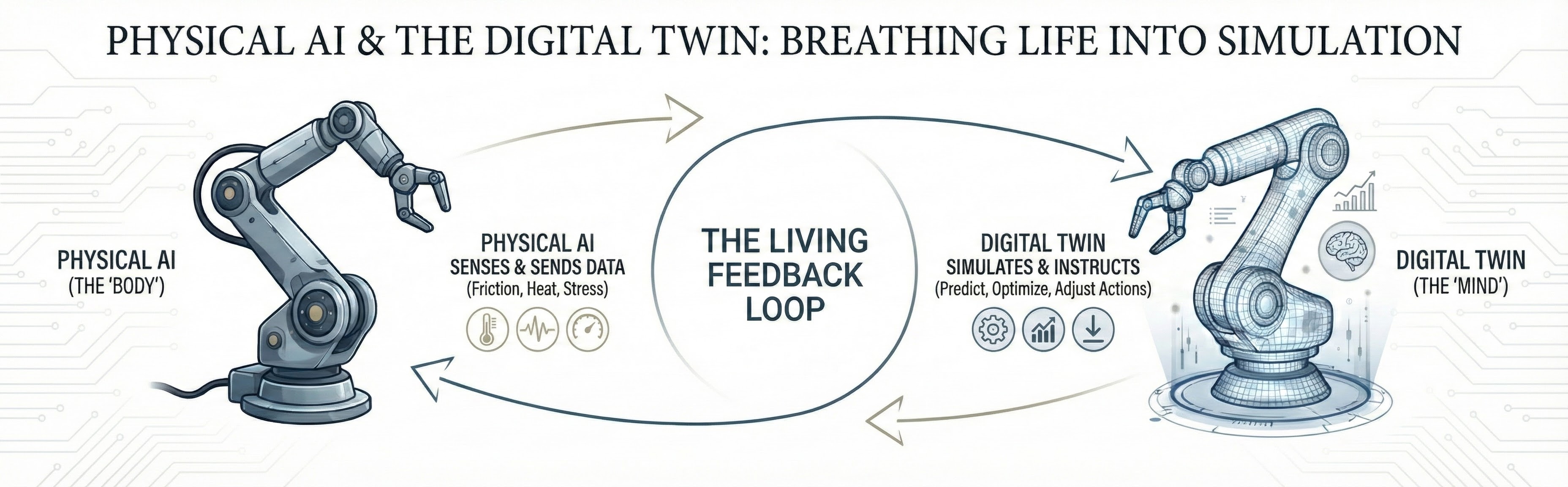
Physical AI and Digital Twins exist to close that gap. They create a loop where the physical world teaches the digital, and the digital helps the physical improve. A system that refines itself because the real world always pushes back.
Physical AI acts as the nervous system, sensing what’s happening right now. The Digital Twin becomes the muscle memory, learning patterns, and predictive capabilities, improving over time.
When these two halves connect quickly enough, simulation stops being pretend—and starts behaving like perception.
The Feedback Loop
---
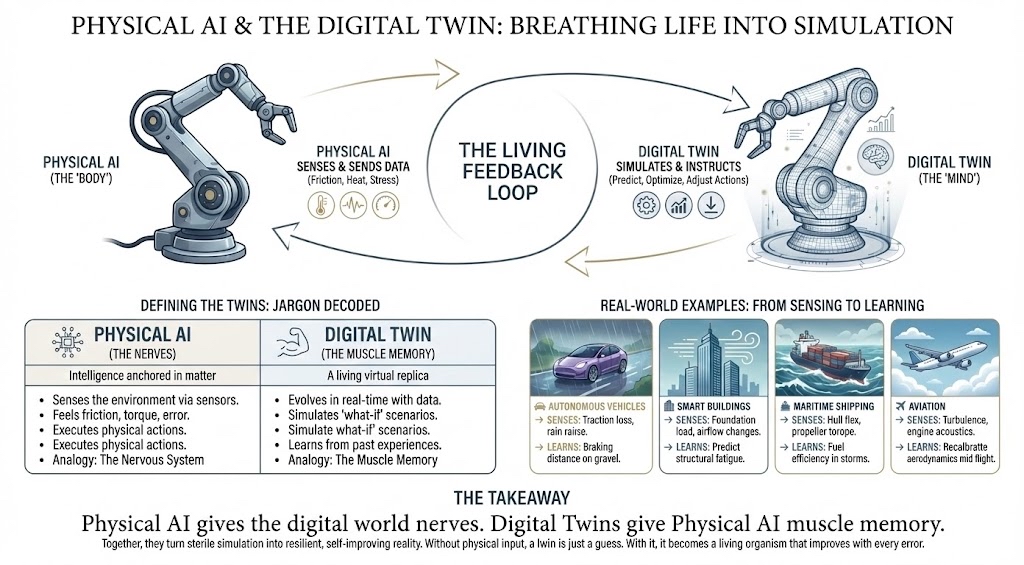
- Physical AI feels the real world and reacts to it.
- Digital Twins learn from experience and forecast what comes next.
- The feedback loop makes each iteration smarter than the last.
---
What We Mean by “AI” (And What We Don’t)
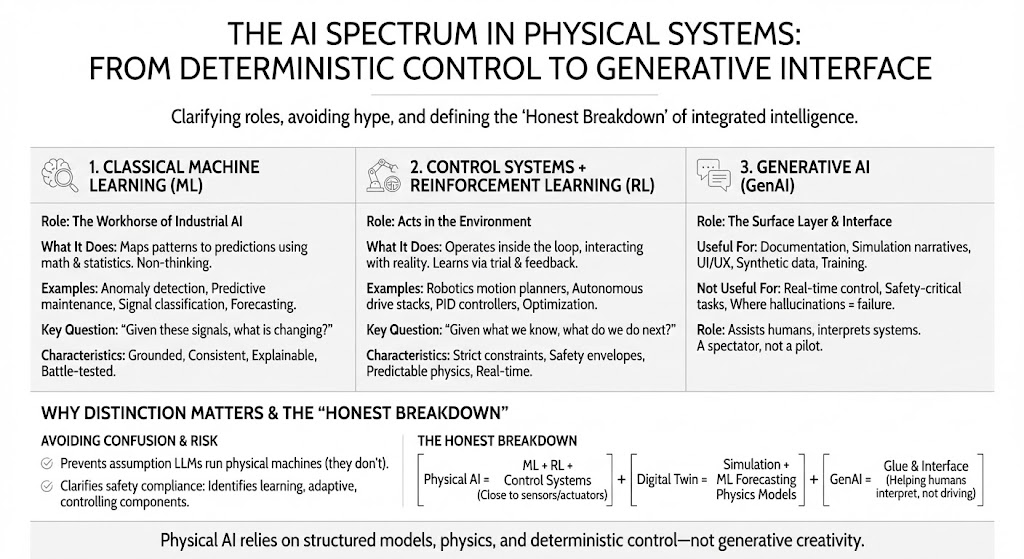
“AI” is a suitcase term packed with too many unrelated ideas. To make sense of Physical AI and Digital Twins, we need to separate the types of intelligence that actually matter in physical systems.
1. Machine Learning (ML)
The workhorse of industrial AI. Used for anomaly detection, predictive maintenance, signal classification, and forecasting. It answers: “What seems to be changing?” Stable. Data-driven. Explainable.
2. Control Systems & Reinforcement Learning (RL)
Systems that act in the world: PID controllers, robotics motion systems, optimization logic, and agents that adapt through feedback. They answer: “Given what we know, what should we do next?” This is where Physical AI lives—tight feedback loops grounded in physics.
3. Generative AI (GenAI)
Useful for interfaces, documentation, operator guidance, and synthetic data—but not suitable for safety-critical or real-time control. Here, GenAI is supporting infrastructure, not the thing steering the machine.
Why this distinction matters
If we don’t separate these categories, “AI” becomes a confusing abstraction. Physical AI is built on ML + control systems. Digital Twins combine simulation + data modeling. GenAI helps humans interpret the system.
This clarity sets the stage for everything that follows.
---
What Physical AI Actually Is
Physical AI is intelligence anchored in matter. It is not a chatbot bolted to a robot or a generic “AI” with actuators attached. It is a fusion of:
- sensors — Strain gauges on a bridge detecting micro‑flex long before inspectors notice anything.
- control logic — A motor controller adjusting torque the moment resistance spikes.
- machine learning — An anomaly detector noticing that a pump’s vibration spectrum has shifted subtly from its baseline.
- feedback loops — A robotic arm correcting its trajectory mid‑movement based on positional error.
- real-time decision layers — A drone adjusting altitude instantly when wind gusts exceed predicted tolerance.
A Physical AI system feels the lived experience of the machine:
- torque changes — A conveyor compensates for sudden load.
- vibration signatures — A gearbox detects early bearing wear.
- alignment drift — A CNC machine notices thermal expansion.
- heat buildup — A battery pack reports a hotspot forming.
- acoustic anomalies — Pipelines hear leaks before sensors measure pressure loss.
- environmental shifts — Agricultural robots adapt to changing soil density.
It learns through interaction with physics. It understands friction because it feels friction. It understands drift because it watches drift accumulate.
Physical AI answers the question: “What is happening right now, and what should we do about it?”
---
What Digital Twins Actually Are
A Digital Twin is not a static 3D model or a polished dashboard. A true twin is a living simulation—continuously updated, continuously corrected, continuously learning.
A twin:
- mirrors current state — A power plant twin showing turbine temperature and efficiency as they evolve.
- absorbs telemetry — A manufacturing line twin ingesting sensor streams from every robot and conveyor.
- compares prediction to reality — An HVAC twin predicting airflow, then reconciling real measurements to detect blockages.
- refines its internal model — A rail network twin adjusting travel-time forecasts based on real braking behavior.
- simulates possible futures — A building twin testing evacuation patterns or structural load scenarios.
Without physical data, a twin becomes a museum piece—accurate once, irrelevant forever. With Physical AI feeding it, the twin becomes a continually updated hypothesis about how the system behaves.
Digital Twins answer the question: “Given everything we’ve learned so far, what happens next?”
---
The Feedback Loop: Where Things Get Interesting
Physical AI and Digital Twins become powerful only when connected.
- The physical world produces signals.
- Physical AI interprets them in real time.
- The Digital Twin absorbs and updates.
- The Twin simulates options and refines understanding.
- Physical AI applies those refinements back in the field.
- The cycle repeats.
This is not hierarchy—it is harmony. The machine learns how to respond. The twin learns why things are happening. Together, they evolve.
---
Why This Matters
Systems rarely fail due to a lack of data. They fail because they fail to connect:
- data → context — Physical AI filters noise, identifies patterns, and surfaces what matters.
- context → prediction — The Digital Twin updates its model and forecasts emerging behavior.
- prediction → action — Physical AI converts insight into real-time adjustments.
Reality drifts. Models don’t—unless we force them to. Physical AI + Digital Twins are the first practical way to:
- detect micro-failures early — Physical AI senses deviations immediately; the Twin interprets them.
- adapt to environmental shifts — The Twin adjusts its assumptions; Physical AI adjusts its actions.
- reduce downtime — Prediction + real-time correction prevents failures instead of reacting to them.
- improve safety — The loop sees abnormal patterns earlier than human monitoring.
- increase resilience — Continuous learning replaces brittle assumptions with adaptive insight.
These systems don’t seek perfection—they seek truth, shaped by continuous friction with the real world.
---
Examples in Practice
Autonomous Vehicles: Learning Grip
Traction changes with surface texture, moisture, and temperature. Physical AI studies those signals; the Twin teaches the fleet what they mean.
Smart Buildings: Learning Stress
Buildings always flex. A Twin distinguishes routine flex from early fatigue.
Ships: Fighting Entropy
The ocean is a slow-motion demolition machine. Physical AI detects micro-damage before it becomes a failure.
Aviation: Learning Stability
Stress moves through an airframe in complex patterns. Twins learn these patterns across flights, not after landing.
Each example reinforces the same point: systems learn because the world pushes back.
---
Failure Modes (And How to Avoid Them)
Sensor Drift
Hardware lies slowly. Without recalibration, the Twin drifts into confident wrongness. Example: A turbine’s vibration sensor drifts, causing false alarms. Countermeasure: Scheduled verification and cross-sensor checks.
Latency
“Real-time” delayed by seconds is fiction. Example: A warehouse robot reacts to stale sensor data, causing near-collisions. Countermeasure: Push inference to the edge.
Feedback Loops Amplifying Error
A correction becomes a miscalibration, which becomes another correction. Example: An HVAC system chases imaginary pressure changes. Countermeasure: Human-in-the-loop and reference twins.
Corrupted Data
Bad inputs create hallucinated stability. Example: A spoofed temperature sensor masks a heat spike. Countermeasure: Authentication, encryption, and sanity checks.
Over-Automation
When no one asks “why,” fragility replaces judgment. Example: An automated maintenance scheduler misses an edge-case failure. Countermeasure: Visibility, auditability, and accountable oversight.
---
The Takeaway
Physical AI gives machines nerves. Digital Twins provide them with muscle memory. Together they create continuous, adaptive improvement.
The goal isn’t perfection—it’s a system that learns because the real world never stops teaching.