Article Detail
Nothing to Fear: Physics of the Bubble
Something I wish I knew before I felt the bubble bobbing.
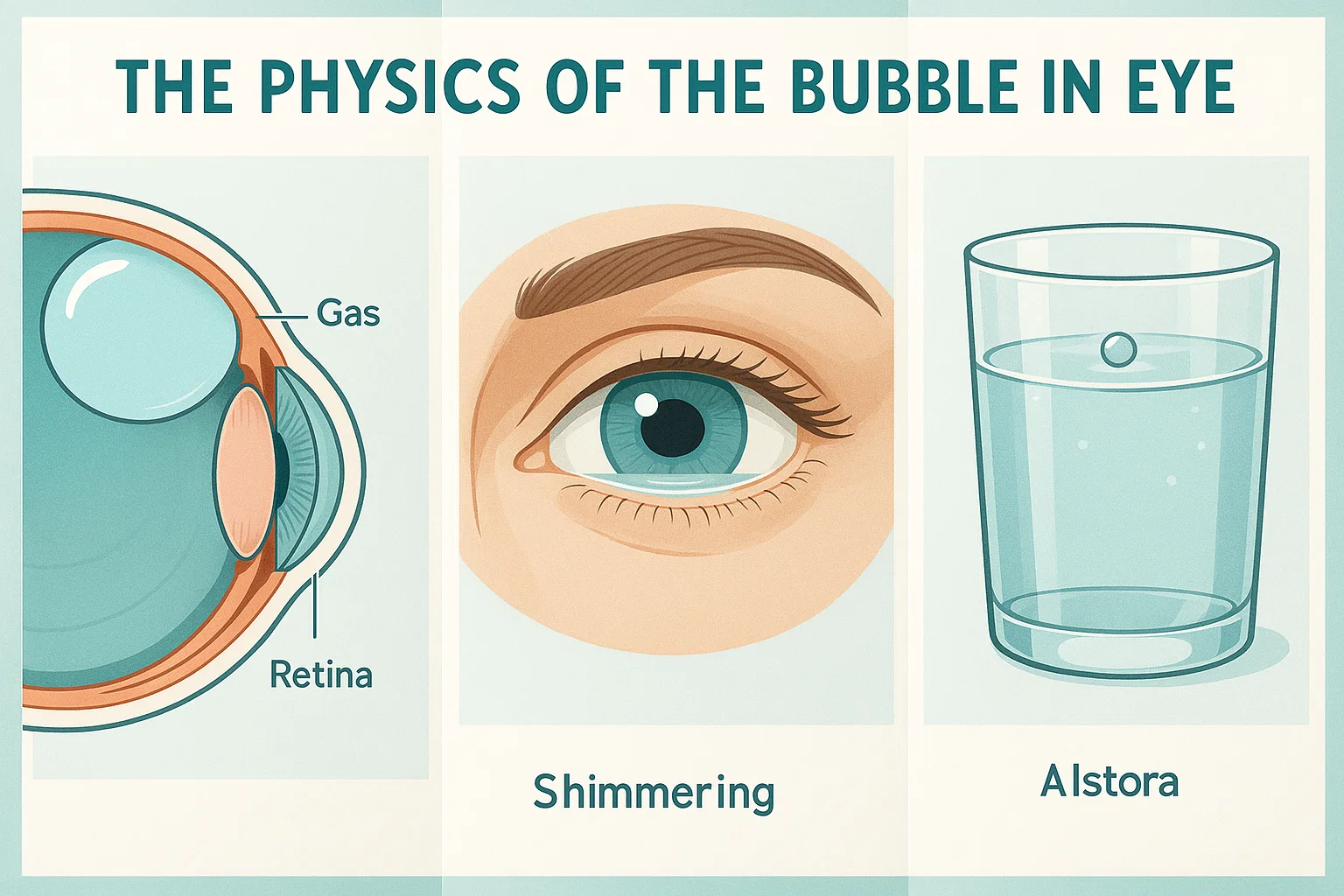
Disclaimer: This explainer is about physics, not medicine. It helps you understand what the gas bubble in your eye is doing and why it looks or feels strange. Always follow your surgeon’s instructions. If you ever have pain, sudden changes in vision, flashing lights, or a curtain-like shadow, call your eye care team right away.
---
Why the Bubble Is There
After certain retinal surgeries, surgeons place a small gas bubble inside your eye. Its job is simple: press gently against the retina to help it heal. That’s the medical part. The physics part is what you’ll notice day to day.
---
Why You See the Bubble at the Bottom
Inside your eye, the bubble floats to the top (gas is lighter than fluid). But the retina flips images—just like a camera lens—so you see it at the bottom of your vision.
Think of it like looking into a glass of water with a bubble at the top. Your eye is just projecting that bubble in reverse.
---
Why It Moves More as It Gets Smaller
When the bubble is big, it presses firmly against the retina and barely jiggles. As it shrinks, it becomes freer to slosh around—like a marble rolling in a glass half-full of water. That’s why you suddenly notice it bouncing or wobbling more in the later weeks.
---
Why It Vanishes on Your Side
If you lie on your left side, the bubble floats sideways to the new “top” of your eye. That pulls it out of your central vision, so it disappears from sight. Like the bubble in a carpenter’s spirit level, it always finds the highest point.
---
Why You Sometimes Feel It
Most of the time you only see the bubble. But as it shifts, it can press gently on different parts of the eye wall. Your brain sometimes interprets that as pressure—especially if your sinuses are already swollen from allergies. It’s not sharp pain, just an odd sensation.
---
What if You Have Two Bubbles?
Some patients have a bubble in each eye. Then your brain has to merge two different distortions. The result can feel surreal—like walking through a snow globe, or watching horizons that won’t quite line up. Many people cope by closing one eye at a time until the bubbles shrink.
---
The Good News
Every day the bubble gets smaller. It will eventually disappear entirely as your body absorbs the gas. Until then, treat the bubble like a quirky passenger—strange but harmless, and proof that the physics experiment inside your eye is working.