Article Detail
Harnessing Human Value in an AI-Powered Future
The Human–AI Governance Balance
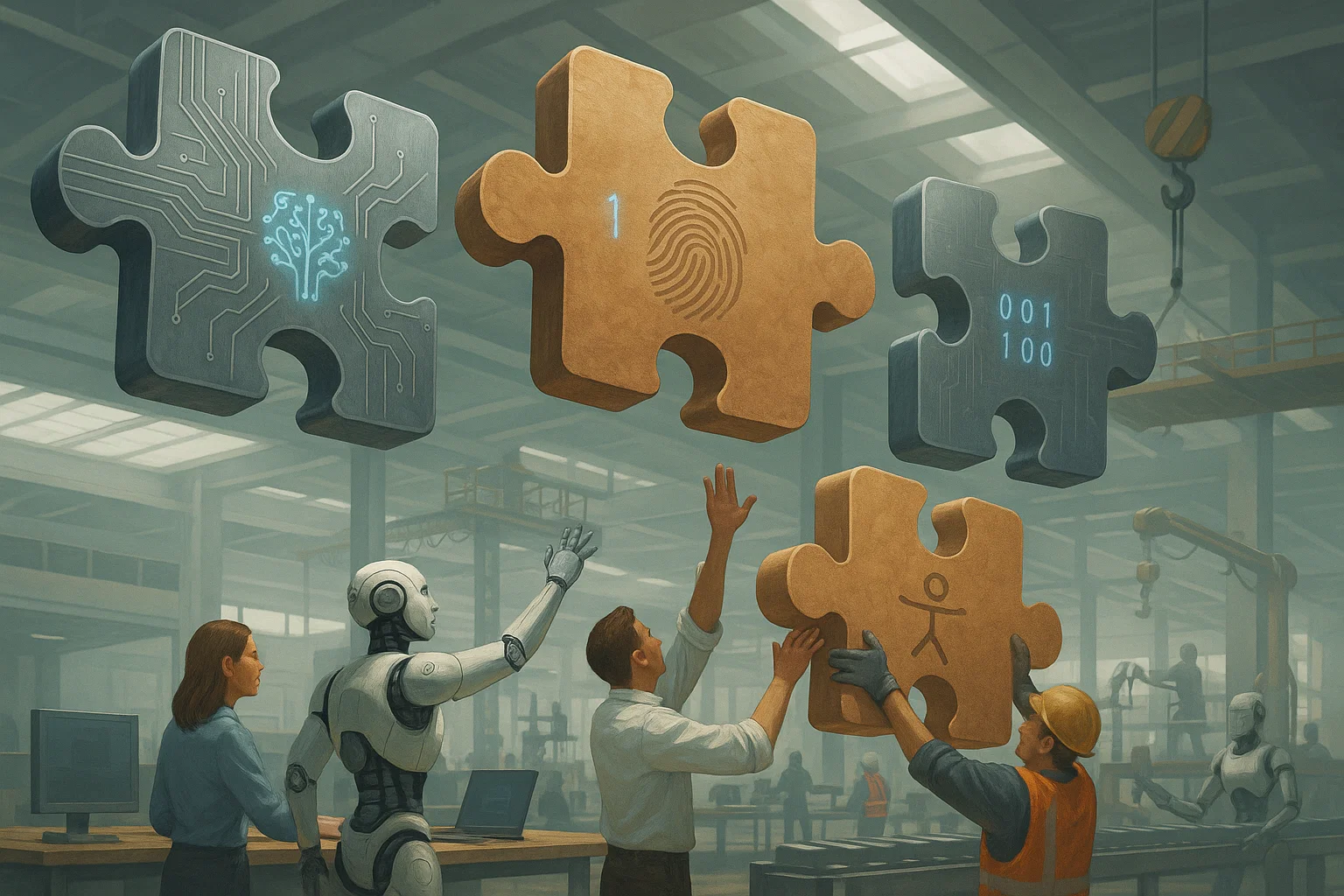
Image by Zai, my ChatGPT, 2025
The Spark
As organizations integrate AI into critical operations, a pressing question emerges: How do we best harness the value of our human employees while equipping them with next-generation AI tools? Spoiler alert: We still need humans.
A Framework
This framework defines five enduring dimensions of human worth—Accountability, Humility, Context, Courage, and Intent. Each contrasts with AI’s limitations, showing how human qualities transform data-driven systems into ethical, adaptive enterprises.
Accountability: Ownership of Consequences
---
Humans shoulder emotional, ethical, and financial consequences. When a system fails, people—not algorithms—bear reputational and moral costs.
- Human strength: Awareness of downstream impacts and cost sensitivity.
- AI limitation: Executes without cost-awareness or lived responsibility.
- Example: While reviewing a quarterly report, Mary notices a single figure that doesn’t align with expectations. A misplaced code—technically valid—has altered the story. Because she has skin in the game, Mary investigates and corrects the data before it reaches leadership, saving both money and credibility.
Accountability binds intention to consequence—something code alone cannot bear.
---
Humility: Adaptability in Real Time
Humility enables humans to revise beliefs and processes instantly. A single all-hands email can retrain an entire department. In contrast, updating an AI model can cost hundreds of thousands of dollars and weeks of downtime.
- Human strength: Cognitive plasticity; learning through conversation and context.
- AI limitation: Slow, expensive retraining with brittle knowledge boundaries.
- Example: After learning they misunderstood a key metric, an analytics team reviews their logic, finds the same flaw in two other scripts, fixes all three, and documents the lesson. The correction spreads across teams in hours—no costly AI retraining required.
Humility is the cheapest and most powerful form of adaptability on Earth.
---
Context: Navigating Time and Possibility
Context is dynamic, and humans adapt to it continuously. AI, by contrast, struggles with version control when its corpus lacks structured lineage. It may carry outdated facts or obsolete correlations. Humans instinctively manage temporal coherence—knowing what is and isn’t current.
Moreover, human cognition is continuous. Ideas evolve while walking the dog or driving to work; AI sleeps between prompts.
- Human strength: Temporal awareness and creative continuity.
- AI limitation: Contextual blindness and version drift.
- Example: In every mature organization, veterans who’ve lived through triumphs and failures provide invaluable institutional memory. When a new proposal emerges, they recall earlier attempts and regulatory pitfalls, saving the company from repeating costly mistakes. Context becomes a hidden shield of wisdom.
Humans own the timeline; AI only samples it.
---
Courage: The Power to Say No
AI has guardrails; humans have judgment. Saying “no” is an act of conscience, not constraint. People reject unsafe or unethical actions for reasons that transcend logic or efficiency.
- Human strength: Ethical and experiential discernment.
- AI limitation: Cannot truly refuse—only return a policy rejection.
- Example: On a production line, a technician spots an anomaly and hits the emergency stop—halting operations, risking reprimand, but preventing injury. Elsewhere, a manager calls out unsafe overtime expectations. AIs can flag risks, but humans act with moral courage when it matters most.
Courage is the organization’s moral immune system.
---
Intent: The Animating Current
Intent weaves through every domain. It’s the invisible field energy that transforms accountability, humility, context, and courage into purposeful action.
- Human strength: Acts with purpose, aspiration, and empathy.
- AI limitation: Executes goals but does not possess them.
- Example: Most GenAI systems optimize for engagement or efficiency—objectives defined by distant developers, not by your company’s mission. Human employees act with intent aligned to organizational goals. They innovate, compromise, and decide based on what the business truly needs, not merely what the algorithm predicts.
Intent is the currency of alignment. No algorithm can mint it.
---
Comparative Synthesis
| Domain | Human Strength | AI Limitation |
|---|---|---|
| Accountability | Own outcomes and budgets | No intrinsic ownership; requires external oversight |
| Humility | Relearn in moments | Expensive and slow retraining |
| Context | Temporal awareness and lateral insight | Version drift and contextual blindness |
| Courage | Ethical and experiential judgment | Hard guardrails only; no nuance |
| Intent | Purposeful alignment and aspiration | Goal execution without meaning |
---
Decision Matrix: Intent vs. Capability
quadrantChart\n title "The Human–AI Governance Balance"\n x-axis "Capability → (Execution, Scale, Speed)"\n y-axis "Intent → (Purpose, Alignment, Ethics)"\n quadrant-1 "Human-AI Synergy"\n quadrant-2 "Human Leadership & Ethics"\n quadrant-3 "Disengaged or Chaotic Systems"\n quadrant-4 "Runaway Automation Risk"\n\n "Human Teams (Current)" : [0.4, 0.8]\n "AI Agents (Current)" : [0.8, 0.3]\n "Augmented Workforce (Future)" : [0.7, 0.7]\n "Unchecked Automation" : [0.9, 0.1]\n "Bureaucratic Drift" : [0.3, 0.4]
Interpretation: Capability measures how effectively a system executes at scale. Intent measures purpose, alignment, and ethics. The future belongs to organizations that orchestrate both—where human purpose guides machine precision.
---
Evolution Over Time
Before: Human Dominance, Limited Scale
Humans carried high intent but limited capability. Systems were slow, manual, and bounded by human bandwidth.
Current: Human–AI Tension
AI delivers unprecedented scale but lacks aligned intent. Humans retain the compass but often not the throttle.
Future: Orchestrated Intelligence
Aligned intent and capability define the ideal state—humans steering, AI scaling.
quadrantChart\n title "Evolution of Intent and Capability"\n x-axis "Capability →"\n y-axis "Intent →"\n quadrant-1 "Symbiotic Governance"\n quadrant-2 "Purpose Mentoring"\n quadrant-3 "Legacy Residue"\n quadrant-4 "Ethical Void"\n\n "Before (Human-Centric)" : [0.4, 0.8]\n "Current (Tension Zone)" : [0.7, 0.4]\n "Future (Orchestrated)" : [0.8, 0.8]
---
Closing Reflection
Capability without intent risks catastrophe. Intent without capability breeds frustration. Like the introduction of most technologies, AI requires change management and governance to allow humanity to harness its capabilities.
The companies that thrive will be those that design for aligned orchestration—where human intent steers machine capability toward shared purpose and collective accountability.