Article Detail
Automated GenAI Dossier Synthesis
From Paper Records to Philip K. Dick’s Minority Report Moments
Introduction
What happens when every scrap of public information about you—court filings, property records, old social media posts, even a data leak—is stitched together into a polished biography by a machine? That’s dossier synthesis. It’s not science fiction; it’s the fusion of cheap data and generative AI. The result: faster, cheaper privacy harms that are already within reach.
This article isn’t meant to scare. It’s meant to show how we got here, why it matters, and what we can do about it.
---
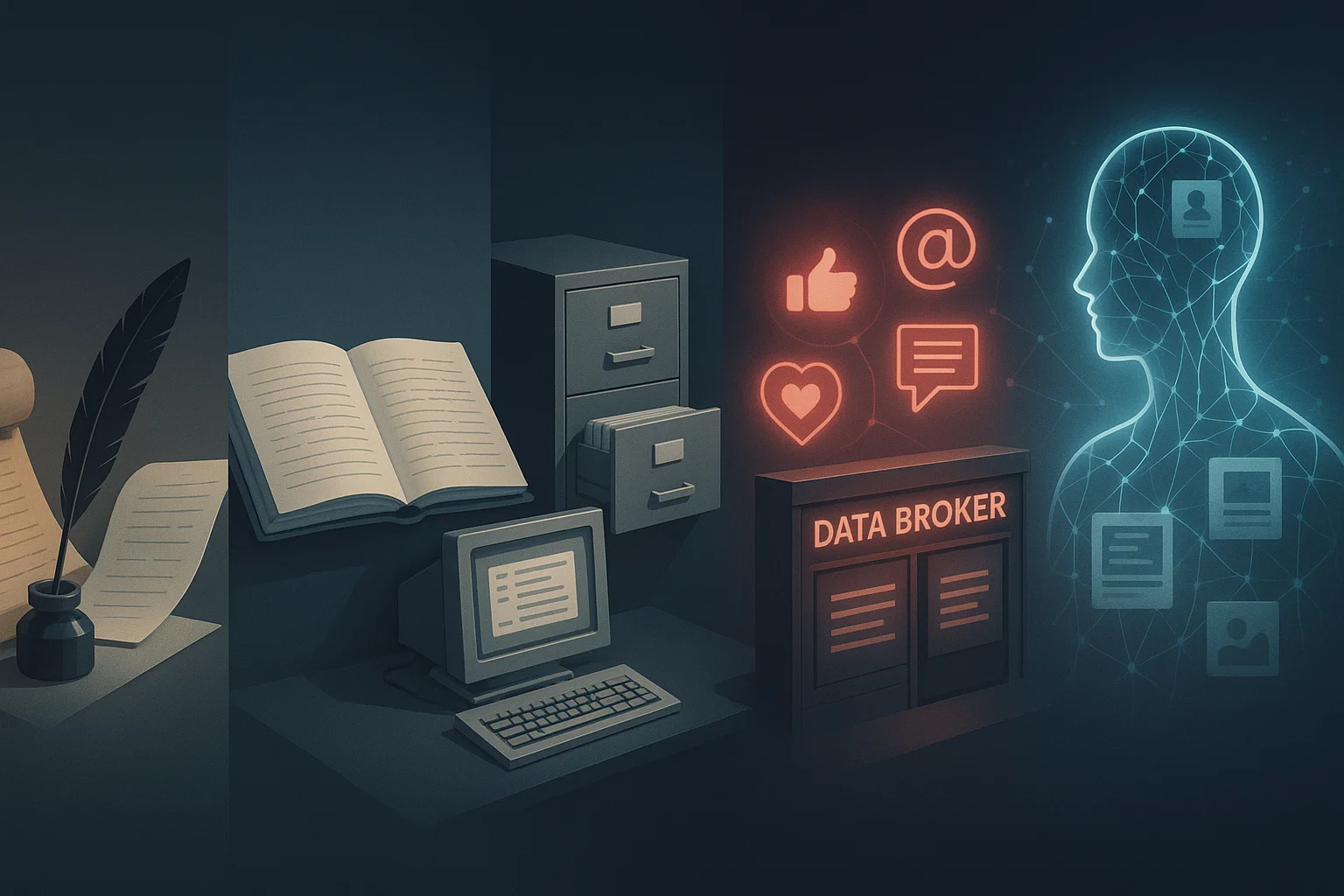
A Timeline of Surveillance Techniques
Pre-modern records (pre-1800s): Information was local. Parish lists, guild rosters, handwritten registers. Privacy was protected by slowness and distance.
The bureaucratic age (1800s–1950s): Central registries, censuses, and court dockets thickened the files, but access still required patience and paper.
Digital dawn (1960s–1990s): Databases, credit bureaus, and early data brokers made information searchable at scale.
The web and social era (2000s–2010s): Search engines and social platforms normalized self-disclosure. APIs and scrapers made collection cheap.
Commercial surveillance (2010s–2020s): Data brokers and ad-tech built behavioral profiles and sold identities in bulk.
The synthesis age (2020s–today): Generative models turn fragments into narratives. Anyone with an LLM can request a dossier, polished and ready for misuse.
Minority Report moment? Philip K. Dick imagined predictive policing. Our version is simpler but real: predictive narratives spun from personal data, without oversight.
---
Why This Matters
The harm is not theoretical. Extremist groups already automate doxxing. Voice-cloning scams and AI impersonations appear weekly. And scammers now compile dossiers on family members, using personal details to con people into sending money or giving away information.
Privacy is no longer individual — it’s a family matter. Your best defenses crumble if your relatives’ data can be mined and weaponized against you.
Consequences include:
- Stalking and harassment amplified by machine-polished dossiers.
- Swatting and violence fueled by synthetic voices tied to real addresses.
- Blackmail and extortion mixing fact with fabricated plausibility.
- Family-targeted scams exploiting relatives’ identities and relationships.
- Reputational harm in workplaces and communities.
---
What We Can Do
We can’t pretend this isn’t possible. But we can act.
For individuals:
- Lock down privacy settings and remove unnecessary personally identifiable information (PII).
- Opt out of data broker lists where possible.
- Monitor breach alerts and credit reports.
- Talk with family about how their information can expose you.
For platforms:
- Enforce provenance and watermarking for AI outputs.
- Rate-limit or block bulk ingestion of personal identifiers.
- Add human review for PII-heavy requests.
For policymakers and law enforcement:
- Crack down on data brokers trafficking sensitive data.
- Build takedown and forensics playbooks for AI-synthesized dossiers.
- Support survivor-first reporting and remediation services.
---
Closing Thoughts
This isn’t a “privacy is dead” sermon. It’s a call for urgency and agency. The same tools that enable harmful dossiers can also help defenders, policymakers, and communities push back.
And this isn’t just about you. It’s about parents, kids, siblings, and friends. Privacy defense is now a team sport. One weak link leaves everyone more vulnerable.
That’s why the response must be collective — vigilance from individuals, responsibility from platforms, and oversight from policymakers. We don’t need precogs to see where this is going. We just need the will to slow it down.
---
Voices We Are Echoing
This piece stands on the shoulders of many who have warned about the erosion of privacy and the misuse of technology:
- Philip K. Dick, whose Minority Report imagined futures where predictive systems stripped people of agency.
- Shoshana Zuboff, whose book The Age of Surveillance Capitalism exposed how tech companies monetize human behavior and personal data.
- The U.S. Department of Homeland Security (DHS), whose 2024 report The Impact of Artificial Intelligence on Criminal and Illicit Activities outlined how generative AI could amplify existing threats.
- The Federal Bureau of Investigation (FBI), which has issued public service announcements warning of AI-enabled voice cloning, scams, and impersonations.
- Cybersecurity researchers, who continue to demonstrate how generative AI can be coaxed into misuse as easily as it can be harnessed for good.
- Survivor advocates and journalists, who remind us that doxxing, swatting, and harassment are not abstract — they are lived dangers.
We echo their concerns not to sensationalize, but to continue the work of pushing for systemic safeguards.
---
Call to Action: If this article made you uneasy, good — it was supposed to. Share it with someone who still thinks of privacy as a personal choice, not a systemic risk. Start the conversation with your family, because their safety is tied to yours.