Commentary
When an AI Conversation Sounds Concerned
Text can signal a need for care without becoming a clinical assessment
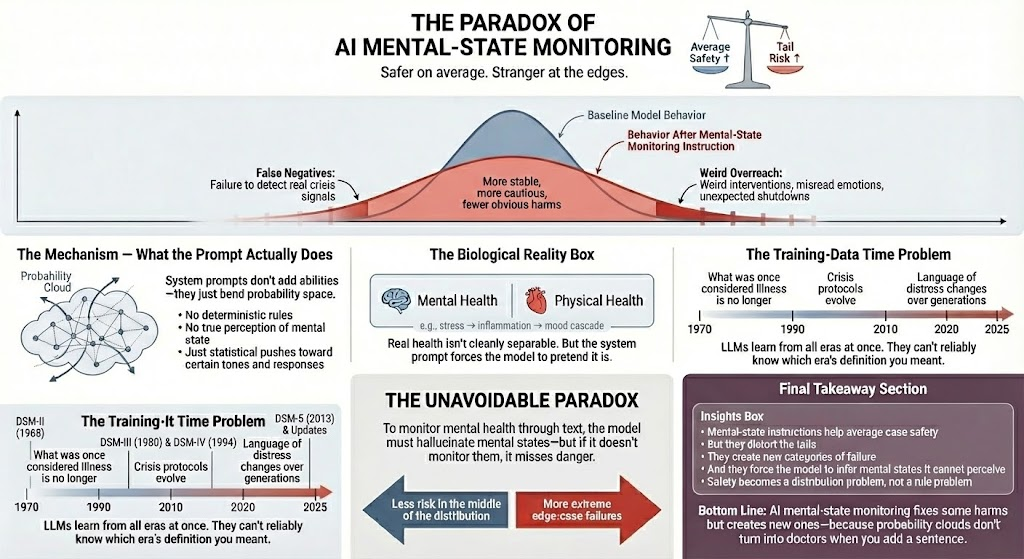
The Spark
I have watched a chatbot shift into a careful, concerned tone after a difficult question. The tone can be kind. It can also invite a mistaken conclusion: that the system has recognized a person’s mental state in the way a clinician, friend, or crisis counselor might.
It has not. A language model can respond to the words in front of it. It cannot establish why those words were written, what is happening off-screen, or what support a person has. That limit matters most when the stakes are high.
Support Is Not Assessment
An AI system may be designed to offer a calmer response, encourage a pause, or suggest reaching out to another person when a conversation appears concerning. Those are interaction choices, not a diagnosis. They can be useful only when they are honest about their limits and point people toward human help rather than pretending to replace it.
The distinction is practical:
- A supportive reply can acknowledge that a person may be having a hard time.
- A clinical assessment requires information, judgment, and accountability that a chat does not provide.
- A crisis response needs a path to a trained human or local emergency service, not a longer automated conversation.
For immediate help in the United States, the 988 Suicide & Crisis Lifeline offers call, text, and chat support. If someone is in immediate danger, contact local emergency services. The Lifeline’s current guidance is here.
Design the Escalation, Not the Illusion
The important design question is not whether a model can infer a private inner state from text. It cannot settle that question responsibly. The question is what the system should do when its conversation creates a reasonable concern.
A responsible workflow names the boundary in advance:
- Define the limited task: supportive language, resource routing, or a prompt to contact a person.
- Explain plainly what the tool does and does not know.
- Provide a human escalation path that works without the AI.
- Test the experience with relevant experts and affected people, including its failures and confusing edge cases.
- Keep accountable people responsible for the policy and its review.
This is consistent with the broader risk-management lesson in NIST’s Generative AI Profile: risks should be considered in the actual context of use, with clear roles, evaluation, and governance rather than a generic claim that a model is safe. NIST AI 600-1 is voluntary guidance, not a clinical standard, but its emphasis on context and accountability is useful here.
What Users Can Keep
The safest personal rule is modest: use an AI conversation for words, options, or a reminder to reach out—not for a verdict about your own or anyone else’s mental state. If the concern is real, bring it to a person who can respond in the real world.
That does not make AI irrelevant. It gives the tool a clear, humane role: help lower the friction of seeking support while leaving care, judgment, and responsibility with people.