Commentary
Reinforcement Training for Leaders
A satirical thought experiment about attention, incentives, and accountability
The Spark
Last night I made a sarcastic comment to Zai, my chatbot, about a headline that seemed determined to turn three unrelated mishaps into a pattern. “What’s the big deal,” I asked. “Everyone knows bad luck comes in threes.”
Zai missed the sarcasm and gave me a careful little dissertation on urban legends. That was amusing. It also gave me a better question: what do public rewards teach people to repeat?
The Realization
The comparison to reinforcement learning is a metaphor, not a claim that leaders are algorithms. People have values, obligations, advisers, institutions, and the capacity to refuse an incentive. Still, attention is a feedback signal. If a leader, commentator, or organization repeatedly receives more money, coverage, applause, or online reach for a certain performance, that performance becomes easier to repeat.
That does not make the audience solely responsible for misconduct. It does mean that we should notice what we reward—and what we treat as entertainment when it is actually corrosive.
A Fictional Simpsons Short
INT. SPRINGFIELD TOWN HALL – DAY
Mayor Quimby steps to the podium, fiddling with his tie.
QUIMBY:
“My fellow Springfieldians, the escalator at the Kwik-E-Mart stopped. Clearly… sabotage!”
The crowd gasps. News cameras flash. A “BREAKING NEWS” banner floods Channel 6. Donations pour into a “Save Quimby” jar.
LISA (facepalming):
“He’s just making things up. It’s random malfunctions.”
BART (grinning):
“Yeah, but watch what happens.”
Quimby eyes the jar, smirks, and tries again.
QUIMBY:
“And then the teleprompter! Also sabotage! Triple sabotage!”
The jar overflows. The crowd roars. The chyron blinks “EXTRA BREAKING NEWS.”
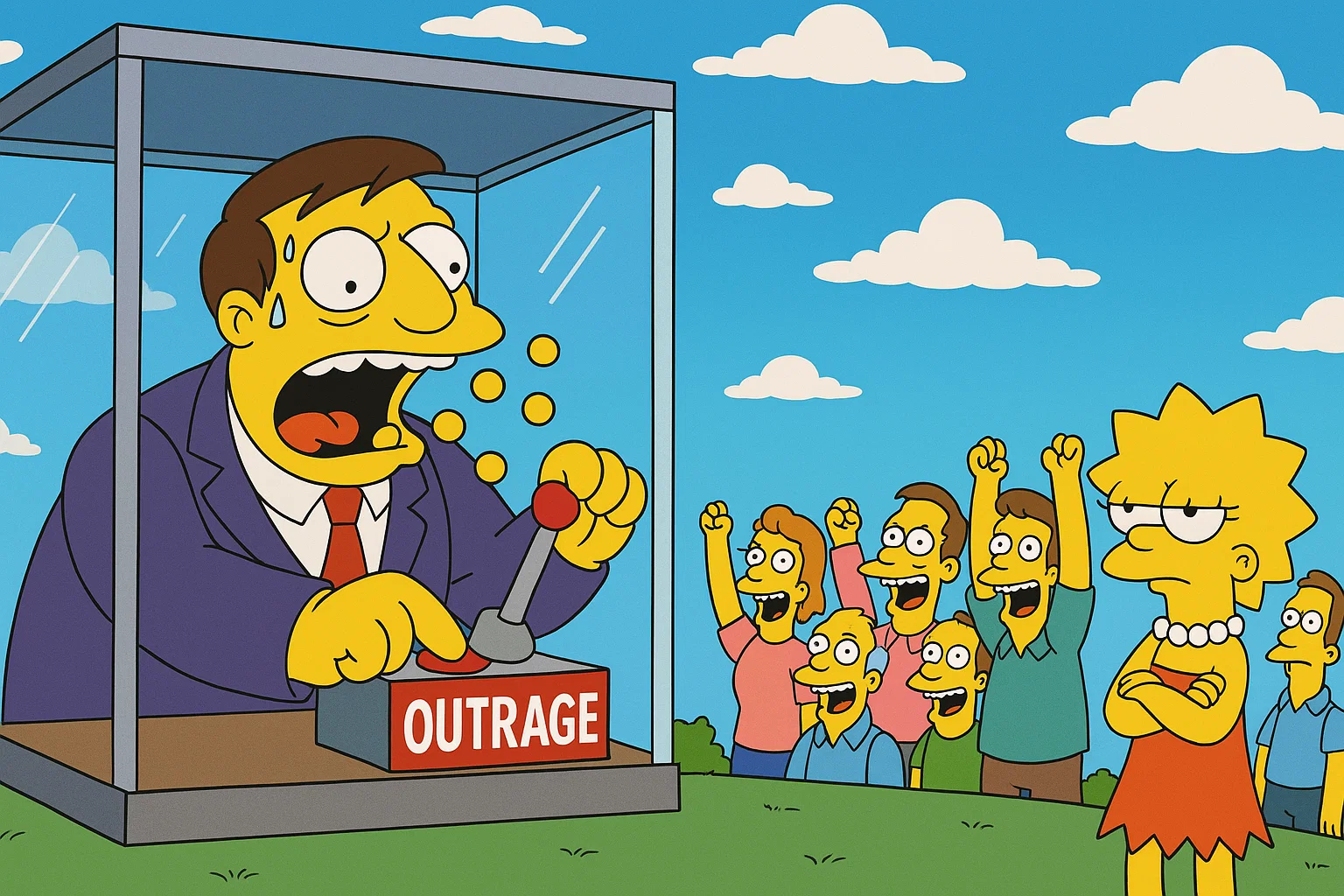
CUT TO – A giant Skinner box in the corner. Quimby scrambles inside, hammering a lever labeled “OUTRAGE.” Each press drops cheese into his mouth as the town cheers like it’s a pep rally.
LISA (deadpan):
“We trained him. He’s just doing what works.”
HOMER (clapping):
“Mmm… cheese pellets. Wish I got rewards for yelling nonsense!”
MARGE (concerned):
“Homer, you do. Every day.”
Cue laugh track. Credits roll over Quimby furiously pounding the lever.
What the Metaphor Is For
Lisa’s line is the point of the joke: we trained him. Public figures do not emerge from nowhere, but neither do they operate without agency. We can hold leaders responsible for their choices while asking what our attention habits encourage.
That leaves a smaller and more useful question than “Why are leaders like this?” What would we have to reward—accuracy, restraint, correction, and real work—to make those behaviors easier to sustain?