Commentary
Physical AI and Digital Twins
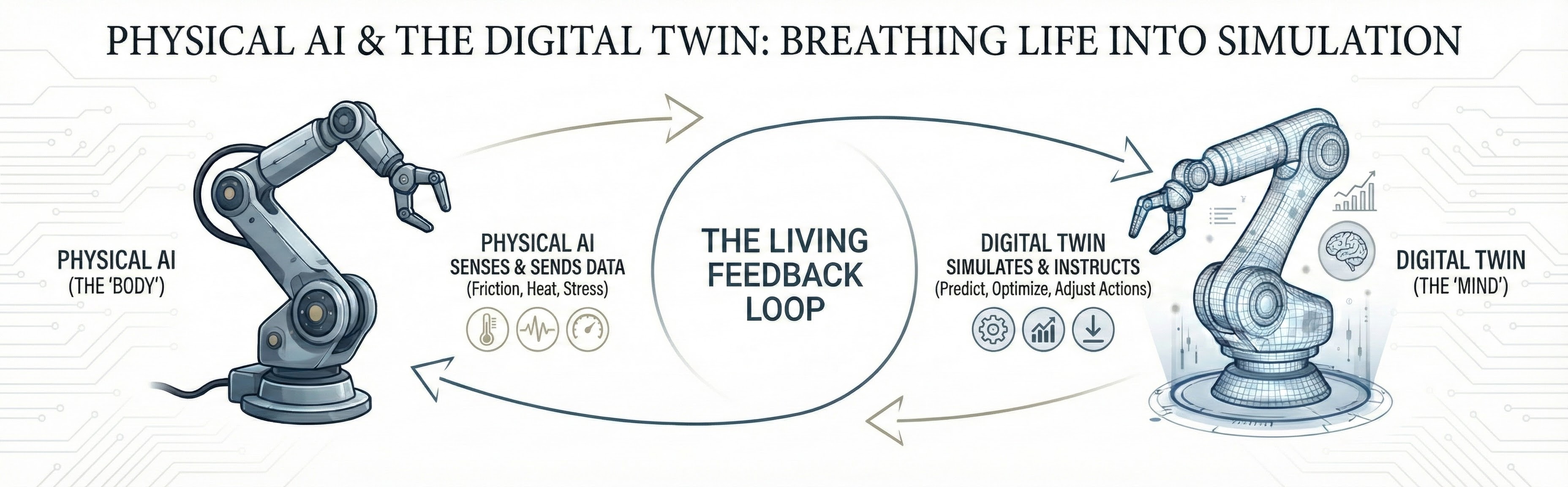
A digital twin earns its name when it remains connected to the physical system it represents
The Spark
Generative AI has made “AI” feel like a conversation on a screen. But many important AI-adjacent systems have a much more demanding job: they observe physical equipment, form a view of its condition, and may inform a person or a controller that can change what the equipment does.
Two terms appear often in that work: physical AI and digital twin. They are useful terms, but neither should hide the engineering underneath.
Start With the Physical System
The physical system is the thing with heat, wear, delay, imperfect sensors, and consequences: a pump, a building, a production line, or a vehicle. A useful digital representation must earn trust against that reality.
NIST describes a digital twin as a type of computer model of a physical system and notes that the field does not yet have one universally accepted definition. The practical point is clearer than the terminology: the representation has a stated purpose, known inputs, and a way to compare its view with the system it represents. NIST’s digital-twin work and its discussion of definitions and state of the art make that connection and validation central.
A dashboard can be useful without being a twin. A simulation can be useful without being continuously connected to the asset. Calling every visual model a “digital twin” erases the important questions: What does it represent? How current is it? How do we know it is wrong?
What I Mean by “Physical AI”
“Physical AI” is not a settled technical category, so I use it as a plain-language umbrella for systems that combine some of these elements:
- sensors and telemetry from a physical environment;
- a model, estimator, or machine-learning component that interprets that information;
- decision logic or a human workflow; and
- an actuator or operating procedure that changes the physical system.
Not every part needs machine learning. Conventional control systems remain essential, especially where timing, bounded behavior, and established safety properties matter. Machine learning may help detect a pattern, forecast a condition, or prioritize an inspection. Generative AI may help an operator read a manual, summarize a log, or draft an explanation. Those are different jobs with different failure modes.
An Illustrative Cooling-System Loop
Consider a cooling-water pump in a building. This is an illustrative design, not a description of a deployed system.
Sensors report flow, pressure, temperature, vibration, and power draw. A representation of the pump and its operating conditions can compare the signals with expected ranges and show an operator that the system is drifting from its normal behavior. A model might estimate the effect of a change in speed before anyone applies it.
The important boundary is authority:
- the twin may observe and forecast;
- a maintenance engineer may decide whether the diagnosis is credible;
- an established controller may make only the changes it is designed and authorized to make; and
- a generative-AI assistant, if used at all, may explain the evidence to the operator rather than issue real-time control commands.
That division is not a disappointment. It is how a useful system stays legible.
The Questions That Make a Twin Useful
A worthwhile design answers these questions before it promises intelligence:
- Scope: Which asset, operating state, and decisions does the representation cover?
- Freshness and quality: How late, missing, noisy, or miscalibrated can the incoming data be before the output is no longer trustworthy?
- Validation: What observation will show that the model’s prediction is wrong, and who investigates that mismatch?
- Authority: Is the result advisory, supervisory, or permitted to trigger a bounded action? Who can override it?
- Fallback: What happens when sensors fail, communications lag, or the model is unavailable?
These questions turn a compelling diagram into an operating design. They also make room for the different risks in a particular setting. A recommendation for scheduling maintenance is not the same thing as a command that changes equipment while people are nearby.
Trust Is a Continuous Job
The NIST AI Risk Management Framework organizes AI risk work around governing, mapping, measuring, and managing risk throughout a system’s life cycle. It is voluntary and context-dependent, but the framing is a useful reminder that a model does not become trustworthy because it was accurate in a demo. It has to be monitored in the conditions where people rely on it. NIST AI RMF 1.0
For physical systems, that means treating sensor drift, stale data, bad assumptions, and unclear decision rights as design conditions—not embarrassing exceptions. The model should be allowed to say “I do not know,” and the physical system should have a safe, understood behavior when the digital layer is uncertain or absent.
The Opportunity
Digital twins and physical AI are not one thing, and they are not a shortcut around systems engineering. At their best, they give people a more current, testable view of a real system and help them make better bounded decisions.
The real advance is not a machine that sounds certain. It is a tighter, more honest loop between a model and the world that can correct it.