Commentary
AI and the Billable Hour Paradox
How AI Forces Hard Choices Across High‑Skill Professions
The Spark
Early in my career, I was a beltway bandit—an IT consultant working inside the DC beltway, usually on government or government-adjacent projects. We billed some jobs by the hour and others under a fixed bid. The governance around these billing models differed significantly as both consultants and clients tried to balance competing concerns.
This experience raised a question: what happens to professions built on billable hours? How do we make this transition work for everyone?
More recently, I saw a smaller version of this while developing training content and technical articles. A draft that might once have taken several focused hours to produce could now be generated in a fraction of the time with AI assistance. The work did not disappear. It moved.
Instead of spending most of my effort creating the first draft, I spent it validating claims, adding firsthand examples, checking citations, refining the argument, and making sure the article reflected what I had actually observed rather than what sounded plausible. The total time decreased, but the review burden increased because the draft reached a level of polish that could easily be mistaken for correctness.
That experience changed how I thought about professional value. The released capacity was real, but it created a choice. I could use the time to produce more articles, spend more time improving the quality of each one, or simply stop working sooner. AI did not remove the need for professional judgment. It shifted where that judgment created the most value.
TL;DR
AI can shorten parts of high-skill professional work, especially drafting, analysis, research, and documentation. That can release capacity, but it does not tell an organization what to do with the time it saves. The same capacity might improve access and quality, support more work, or make extra complexity cheaper to produce. The important question is how professional judgment, incentives, and human attention shape the choice.
The capacity question
AI adoption is rising, although not evenly across organizations or functions. Stanford AI Index That means many professions are beginning to confront a familiar problem in a new form: when a task takes less time, how should the value of the work be measured and paid for?
Some professional models are built around time: billable hours, project weeks, session lengths, and review cycles. AI will not erase those models overnight, and it will not affect every task equally. But it can change the balance between producing a first draft and applying expertise to validate, refine, and take responsibility for it.
That creates a capacity question. An organization can use released time to reduce friction, broaden access, improve quality, or increase the amount of work it sells. It may also add review steps, documentation, or process that are useful in some cases and wasteful in others.
The technology does not settle that question. Professional norms, contracts, oversight, and leadership do.
The paradox
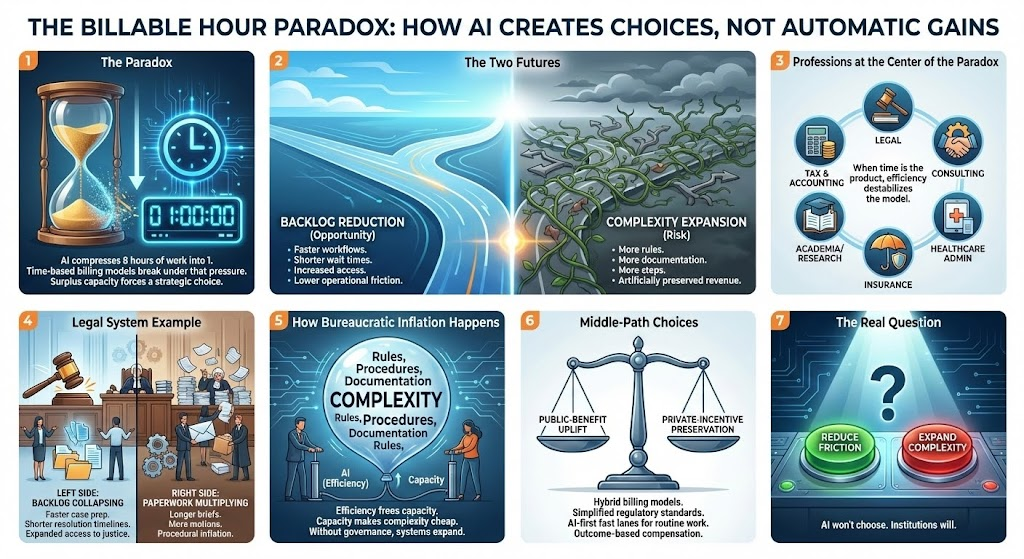
AI can squeeze parts of work into less time. The released capacity can flow in more than one direction.
Use capacity to improve outcomes
- Clear court and agency backlogs.
- Shorten wait times.
- Reduce administrative burdens.
- Expand access for underserved populations.
Make complexity cheaper to produce
- More rules.
- More procedures.
- More documentation.
- More oversight.
- More workflow steps.
Neither outcome is inevitable. The same tool can help a professional serve a client faster, or make it easier to produce a larger stack of artifacts that someone must still read and trust.
Illustrative cross-profession scenarios
The following are scenarios, not forecasts. They make the capacity question visible across several careers and jobs that organize work, price expertise, and protect the public in different ways.
Lawyers and the legal backlog
Where courts and legal-aid systems face backlogs, AI-assisted research and drafting could help people prepare routine material more quickly, subject to appropriate review and due process. In time-billed practices, the same speed can put pressure on the relationship between time, revenue, and client value. That pressure does not make anyone malicious. It makes contract design matter more.
Possible guardrails include hybrid flat-fee or outcome-based billing, carefully scoped backlog-reduction initiatives, and early triage that helps people find the right human help sooner. The point is not that one approach is guaranteed. It is that professional design shapes whether speed becomes access, volume, or new administrative burden.
Consulting and professional services
AI can help consultants produce analysis, models, and presentations more quickly. A firm might use that capacity to reduce costs, serve smaller clients, or spend more time on the parts of an engagement that need judgment. It can also make it easier to inflate deliverables: longer decks, more frameworks, and more templates that look substantial without adding insight.
Value-based contracts, clear disclosure of AI-assisted components, and a genuinely lower-cost rapid-engagement tier are possible ways to keep the focus on the client’s result rather than the apparent volume of work.
Healthcare administration and insurance
AI could simplify parts of coding, approvals, documentation, and claims processing. The value would be faster, clearer decisions without shifting new work or risk onto patients and clinicians. If AI makes it cheaper to create new rules and documentation, administrative burden could also grow rather than shrink.
That scenario argues for asking whether each new requirement improves a patient’s path through the system, and for making routine pathways easier to understand and challenge.
Academia and research
AI can assist with literature reviews, drafting, statistical work, and early-stage peer-review tasks. Institutions may respond by adding requirements, methodologies, and verification rituals. Some could improve rigor; others could make the publish-or-perish cycle heavier.
The useful question is whether a new practice improves the quality of a result, or merely increases the number of hoops through which a researcher must jump.
Tax, accounting, and compliance
AI could make parts of small-business accounting, tax preparation, and compliance easier to understand and execute. If compliance becomes easier to generate, the rules and artifacts around it may also become easier to expand. That is a possibility to design against, not a claim about every regulator or profession.
Here the practical work is simple to state and hard to do: reward clear, usable compliance rather than more compliance theater.
Managing the risks
Efficiency does not guarantee simplification
Efficiency can make complexity cheaper to create. That does not mean complexity will always grow, but it means leaders cannot assume that faster production will automatically produce a simpler experience for clients, patients, students, or citizens.
That is the billable-hour paradox at a larger scale: faster production changes what is affordable to create, not necessarily what is worth asking people to navigate.
Use the released capacity deliberately
AI’s effects will vary by profession, task, and organization. The work is to decide where speed helps and where human review, a simpler rule, or a different contract protects the people on the receiving end.
Leaders across professions need to ask two related questions:
- Where can AI reduce friction or expand access without lowering the quality of judgment?
- Which existing incentives might turn released capacity into more work for someone else to navigate?
Without that discussion, organizations may default to the incentives already built into their contracts and habits.
There is also a human constraint to consider: even if AI accelerates workflows, humans can still manage only a limited number of concurrent projects. Overloading people leads to fractured attention, dropped details, burnout, and loss of the mindful state required for good judgment. The mind does not scale simply because the tools do.
Technology may accelerate, but cognitive bandwidth does not. Incentives, governance, and attention will help determine whether acceleration leads to better service or more overload.
Conclusion: a professional-design question
AI may release meaningful capacity in fields that shape justice, health, learning, finance, and public administration.
We can use that capacity to build more accessible systems, improve the quality of work, and give people back time. Or we can let existing structures turn it into more process, more artifacts, and more work that does not help the people it is supposed to serve.
The technology will not choose among those paths. The people who write contracts, set standards, manage work, and use the tools will.